
Superbroadband is a wireless technology designed to transmit short-range digital data at low power density. This name reflects the fact that the technology occupies the wide bandwidth of the radio spectrum. What is the specific size? In unauthorized applications, hyperbroadband uses short-time pulses, with frequency spectrum ranging from 3.1 GHz to 10.6 GHz. Figure 1: UWB spectrum UWB’s short history broadband...
Superbroadband is a wireless technology designed to transmit short-range digital data at low power density. The name reflects the fact that the technology occupies the wide bandwidth of the radio spectrum. What is it? In unauthorized applications, hyperbroadband uses short-term pulses, with frequency spectrums ranging from 3.1 GHz to 10.6 GHz.
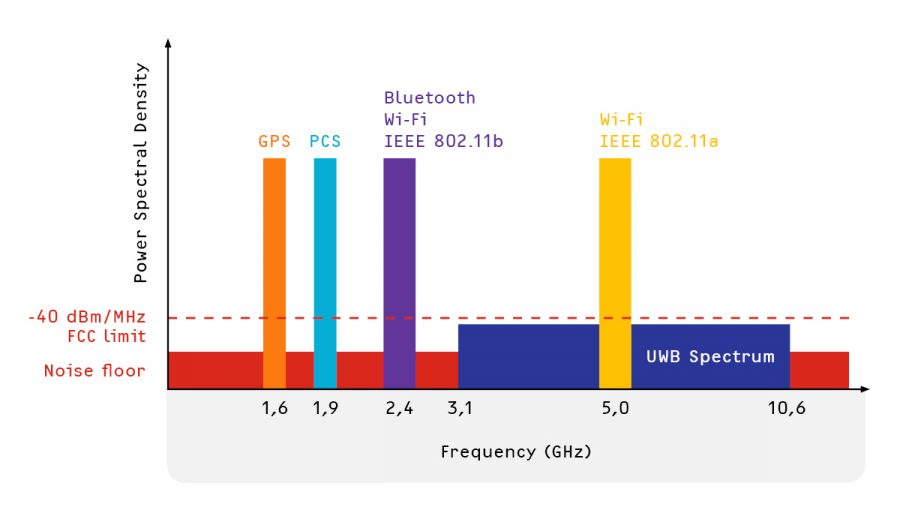
Figure 1: UWB spectrum
A brief history of UWB
Superbroadband can be traced back to the start of the radio, when G. Marconi used a pyrotechnic launcher in transatlantic radio communications. The technology was developed, mainly in the United States, in the middle of the twentieth century, because it proved to be a useful radar and communication technology, and UWB was restricted to military applications from the 1960s to the 1990s.
In 2002, the Federal Communications Commission (FCC) finally granted UWB access to radar, public safety, and data communications applications. The FCC made this decision after growing interest in UWB technology. However, the FCC cut off its wings, setting strict limits on permitted frequency and power.
When the FCC made its decision, the initial excitement was high, but the differences among market participants continued. This led IEE to delay standardization in the following years. If you were interested in details, Steven J. Crowley had written a detailed blog post.
The year's analysts predicted that UWB technology was promising in the wireless personal network (WPANs) market because it could transmit a large amount of data. It would have been good for digital household applications, such as high-resolution video from streaming media.
UWB technology and indoor positioning
However, in some applications, UWB is superior to its competitors, such as radar and precision positioning. Currently, the market for precision positioning technologies shows a trend similar to that of the rapid growth of GPS in different industries.
The reasons why UWB technologies perform well in indoor positioning applications can essentially be attributed to the inherent properties of ultra-broadband signals, e.g. 1:
Prominent performance in multiple paths - Anyone who tries to use precise positioning inside the room will face a problem with multiple paths. This means that the transmission signal is reflected from different surfaces (e.g. walls, equipment and people). UWB technology is more resistant to multiple paths than narrow bands, because it transmits short pulses on a wide bandwidth.
The ability to penetrate the barrier - the low frequency of the UWB spectrum has long wavelengths. This leads to the successful use of the technology for off-the-vision communication. The ability to penetrate different materials makes UWB technology an attractive option for RTLS and radar applications.
There is no interference with other wireless technologies - UWB appears to be noise, given the very low power of the signal and its smooth spread in a wide spectrum. This is a powerful positive factor, because it is difficult to intercept UWB signals, but also allows it to coexist safely with other wireless technologies.
High precision ranging - short pulses from UWB technology can be measured very accurately. Combined with flight time measurements, they enable them to position precisely to centimetres.
In short, hyperbroadband has existed for a long time. Despite the difficulty of starting, this wireless technology has become a serious competitor in the indoor RTLS market.