
UWB combines very short pulses that move at light speed. The time of arrival of the signal is precisely measured on the high bandwidth, so that the location of the transmitter can be determined with high precision. If you have visual contact, you can reach a distance of 250 m (820.2 ft). Depending on the requirements, one of the following methods can be used to calculate location. Two-way ranging (TWR) advantages: maximum...
UWB combines very short pulses that move at light speed. The time of arrival of the signal is precisely measured on the high bandwidth, so that the location of the transmitter can be determined with high precision.
If you have visual contact, you can reach a distance of 250 m (820.2 ft).
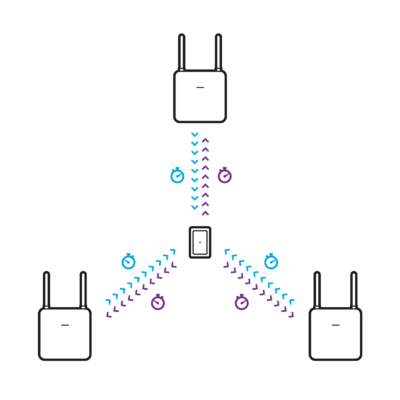
Two-way ranging (TWR)
Advantages: highest accuracy and position stability
How it works. The anchor sends the UWB signal, the sensor returns the signal. The distance is calculated depending on the time between the dispatch and the reception pulse.
Field of application. Workers, real-time positioning of tools and navigation of unmanned transport systems.
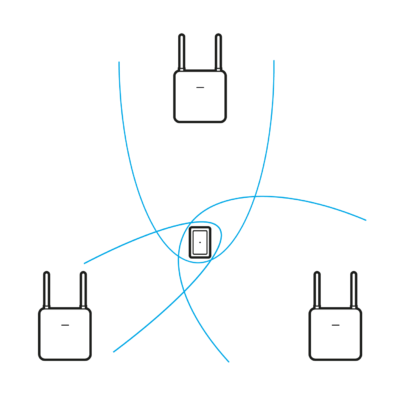
Time difference of arrival (TDoA)
Advantages: lowest energy consumption
How it works. The sensor sends a signal, the anchor is received at different times depending on the distance.
Scope of application. Real-time positioning of a large number of " objects " .
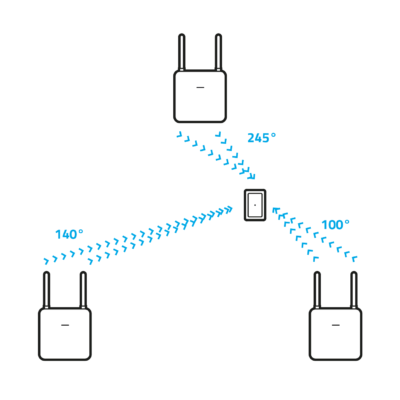
Phase difference of arrival (PDoA)
Advantages: Can be implemented in constrained infrastructure.
How it works. In order to locate the sensor, the phase differential between the receiving signals of the two anchor antennas is assessed and the angle of the signal relative to the anchor is calculated.
Scope of application. Real-time positioning of a large number of " objects " .