
In China, where people's standard of living is growing, the quality of life is also growing.
Java-based pet positioning system server software design
1. Summary
In growing China, people’s standard of living is rising and quality of life is rising, with more and more pets becoming choices, and pets becoming a member of each family. But the problems that follow are also a problem. With 85% of the speed rising, individuals feel that the introduction of pet positioning, a system server, can significantly address the problem. Currently, embedded technologies, communication technologies, and JAVA technology are becoming more mature, with the development of wearable remote-care chips, laying the foundation for real-time care of pets. This article is the design of the Java-based pet positioning system server, which uses existing communication technologies, sensory techniques, and GPS positioning techniques to achieve real-time positioning of pets, allowing real-time care of pets at all times and wherever they occur. I will describe the pet location server from the server’s needs analysis, summary analysis, and how it is designed.
Keywords: JAVA, server, database, GPS location.
Requirements analysis
First, the whole pet positioning system server is based on java technology, and we have to be familiar with java technology, which is the most dependent, basic thing on this server. I'm going to start with the functionality.
The server must first have its own network, its own data centre and its own database. Then its basic application should include the following categories: new user registration, user log-in, query user GPS serial number, write-off user, exit, etc.
A. New user registration: the user is the relevant maintainer of the pet, enters the registration interface, fills in the pet information and the owner ' s information, has its own GPS chip application process upon login, then sends the pet to the door in a relevant manner, wears the pet, opens the running button, starts tracking the pet ' s trip and records the tracks.
B. User login: access to the login page, entry of relevant registration information, account code, etc., and, if you forget the password, click to forget the password, which can be retrieved by binding a mobile phone.
C. Query user GPS serial number: Once the system has been entered, click on the query user serial number to see the user ' s relevant GPS chip serial number and one user can apply for multiple GPS chips to locate different pet tracks.
D. Write-off users: When the pet location server is not needed, access to the write-off user interface is required to write off personal information to avoid exposure.
E. Withdrawal: When the service is not required for certain periods of time, the application may be withdrawn manually in order to save the corresponding resources.
The system has several features: instant positioning, historical trajectories, trajectories analysis, abnormality detection and text messaging.
Real-time positioning: many pets are easily lost and often lost. The system obtains real-time location information for pets through GPS chip positioning, and increases positioning accuracy using wind-free positioning techniques (based on java) and integrated positioning techniques (based on java). The location and movement information is then uploaded to the GPS chip, then the chip is transmitted to the data centre via the web server, which is stored in the data centre. The server extracts the information from the database for integrated processing to PC and to the user's mobile phone application.
B. Historical trajectories: Recording the daily movement trajectory of pets, once an anomaly has occurred, leads to past historical trajectories, daily analysis of the server according to the itinerary, trajectory analysis, where the pets are frequented, and, on the other hand, where the pets are associated.
C. Anomalous detection: For the server, we have our own program to detect whether the software is functioning, and at any given time, the software needs to be tested to see if it is functioning. A test of whether the GPS chip is working properly needs to be performed and documented.
D. SMS alerts: Once a pet is beyond the prescribed range, the server sends an alert on its own initiative and sends a text message to the cell phone to inform the user that the pet is beyond the fixed range.
2. Outline design
- Overview
The needs of the entire system are detailed in the needs analysis phase. This phase will require a summary design of the java-based pet positioning system server software based on the needs analysis. It will address primarily the module design issues for the implementation of the system's needs. It will include the division of the system into several modules, the determination of interfaces between modules, the transmission of information between modules, and the design of data structures, module structures, etc. All outline designs for the system at this stage will be described in detail below.
- Background
The entire system is divided into three parts: mobile phone client build-up, system functionality build-up, and server module build. The following is a structural framework for my overall construction, as shown in figure I:
Figure I Map of the overall structure of the Java-based pet positioning system
- Overall design:
First of all, we're designing the APP client, and the following is a flowchart for the APP application:
Figure II Java-based pet positioning system server AP flowchart
GPS real-time positioning function principle:
The positioning module sends data to the server via the G through the network in the form of a data frame. The data frame format is shown in table 1. The Frame Identification is used to distinguish between different devices. The server obtains a data value by deciphering the command and stores the data in the database according to different devices.
Table 1 Data frame format
frame
control
Longitude
Latitude
Transportation
Transportation
school
head
system
Spend
Spend
move
move
Verification
mark
Character
value
value
Distance
hour
and
Knowledge
Distance
Time
- Running environment
The system consists of three parts, an embedded program to wear devices, a client program installed on a user’s mobile phone, and a user’s data server program. The client server program operates mainly under the Windows system and configures the Java environment
- Interface
The user interface segment, based on the needs analysis results, requires a user-friendly interface that is simple, user-friendly in its design and that is simple, user-friendly in its design, with attention to the overall layout, highlighting important information and processing anomalies, and rationalization in its appearance. Programming in Java language is used in the design language. In general, the user interface of the system should be reliable, simple, clear and easy to operate for learning and use.
The software interface component uses the MySQL interface provided by Java for all access to the database. The server can use MySQL back-up commands for the database to preserve the data.
Hardware interface component, with Java labeled input/output for basic I/O operations and document reading and writing operations.
Internal interface component, using the Java object-oriented concept between modules, achieving class creation, inheritance, etc.
- Module design:
The real-time positioning module, which allows software to receive off-the-shelf loop access to servers, uses POST to obtain real-time longitude information for pets, then interprets the data in long-latitude form and displays it on the visual map interface. The section shows both pets, the location of the owner, and ease of comparison, as shown in figure III.
The campaign custody module is used to monitor the daily activities of pets, displaying information on pets' path, physical consumption, and their functional flow charts, as shown in figure IV. The acquisition and processing of this functionality is carried out on back-office servers. Service accesss servers every 5min to obtain data and deciphers the number of steps, steps, paths, etc., of each calculation of the body's energy data is stored in the local mobile database and server database.
Figure 3 GPS real-time positioning function flow chart
Figure 4 Movement trajectory analysis flow chart
The anomaly detection function and data acquisition are performed in the backstage Service, which also accesss the server every five-min, and then the server uses data analysis to determine whether the AP function is normal. Likewise, our server will send the data package, and still the 4G signal to our GPS chip, which gives a feedback after receiving the package, so that the server will use data analysis to determine whether the GPS is working properly. The functional flow is shown in figure V.
The SMS process is relatively simple, and the functional flow chart is shown in figure VI.
Figure 5 Anomaly detection function flow chart
Figure 6. SMS alarm function flow chart
3. Detailed design
- program flow chart
Figure 7 Program flow chart
- Detailed design of server core module
The Sever core module is located at the core of the entire server. It does not deal directly with users, but provides many basic functions: the Sever core module is responsible for the start-up and closing of the system, while it also carries tasks such as user recognition, data decryption, data compression and data computing. The Sever core module consists of seven components: master control program, ARC, data decompression/compression centre, data encryption centre, log file, service centre and configuration document, as shown in figure 7.
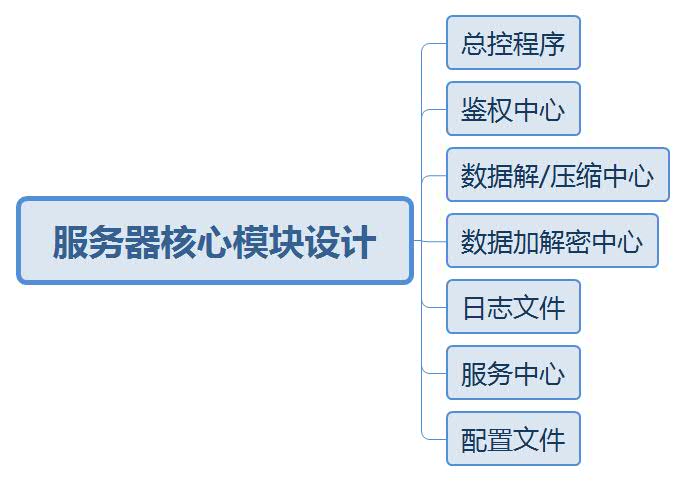
Figure 8 Server core module design
- The overall operating platform of the server and the associated program design.
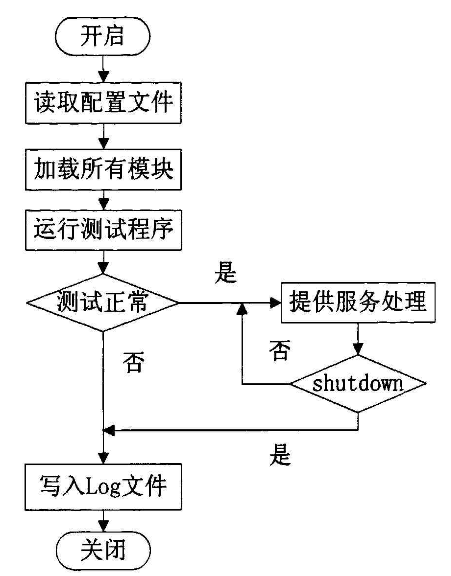
Figure 9: Operation flow chart of the master control program
4. Conclusion
The JAVA-based pet positioning system, which is simple, practical and compatible with modern youth consumption, has great promise for development, but its functionality is not being expanded and is in need of further development and application, and of course it needs to be continually optimized.
5. References:
。
[1]. Zhang Guizhu
Liu Li
Chen Patriot Java Targeted Program Design (2nd edition) Beijing Post and Telecommunications University Press
[2] Bi Guangi. Java programme design example course [M]. Beijing: Metallurgy Industry Press, 2007
[3]. Paul Java Wang, object-oriented program design [M]. Beijing: Tsinghua University Press, 2003
[4]. Goering, Zhou Haiyan.Jsp online bookshop system and case analysis [M]. Beijing: People ' s Post and Telecommunications Press, 2004
[5]. Liu Tenghong, Sun Xiaoming. Information systems analysis and design [M]. Beijing: Science Press, 2003 [6]. Lim Bongje, a thorough study of Java. Beijing: Electronic Industry Press, 2002.